

What the spreadsheet doesn't know
Resources in the ecology of enoughness

The Ecology of Enoughness series explores how we cultivate enoughness—the lived experience of knowing that what matters most is sufficiently supported. You can read the previous two articles in this series here.
Part 2 begins today and will be published in three installments through Saturday. On Saturday, paid subscribers will also receive an accompanying workbook with practices to help deepen the work.
Because I write about wealth and follow people who do the same, it doesn’t take long for my social media feed to become choked with luxury content. Before I know it, I’m being shown articles like “The only shows worth attending at Fashion Week 2026 ” and “Don’t make this mistake when booking your Portofino villa for the summer”, alongside curated carousels full of the most exquisite objects - enameled jewelry featuring zoo animals or the most hallucinogenic Pucci prints found in your mother’s closet from the 80s.
At first it’s fun. I enjoy seeing all the beautiful things. But after a while, I start to feel unsettled. Unsatisfied. Thoughts like “I should have a Cartier tank watch” or “Why don’t I have Sferra linens?” begin to register like real, legitimate complaints. The feeling of general abundance that permeates my life begins to recede and the gnawing feeling of scarcity begins to set in. I begin doing math and checking spreadsheets, running out hypothetical scenarios. Suddenly, everything I have begins to feel like it just isn’t enough.
Nothing about my financial reality has changed. But somehow everything else has. My desires have shifted, my nervous system has become anxious, and the same spreadsheet is now telling a different story. So why do I suddenly feel differently? How could this possibly, in any way, ever, not feel like enough?
The Ecology of Enoughness
I became fascinated by this question of why some people, who by any objective measure clearly possess enough, can’t experience it. Beyond documenting the phenomenon, I wanted to know how to respond to it. Was there a way of living—a kind of tether back to reality, a code to live by—that could return us to enoughness after experiencing drift? These questions led to the creation of a model called The Ecology of Enoughness.
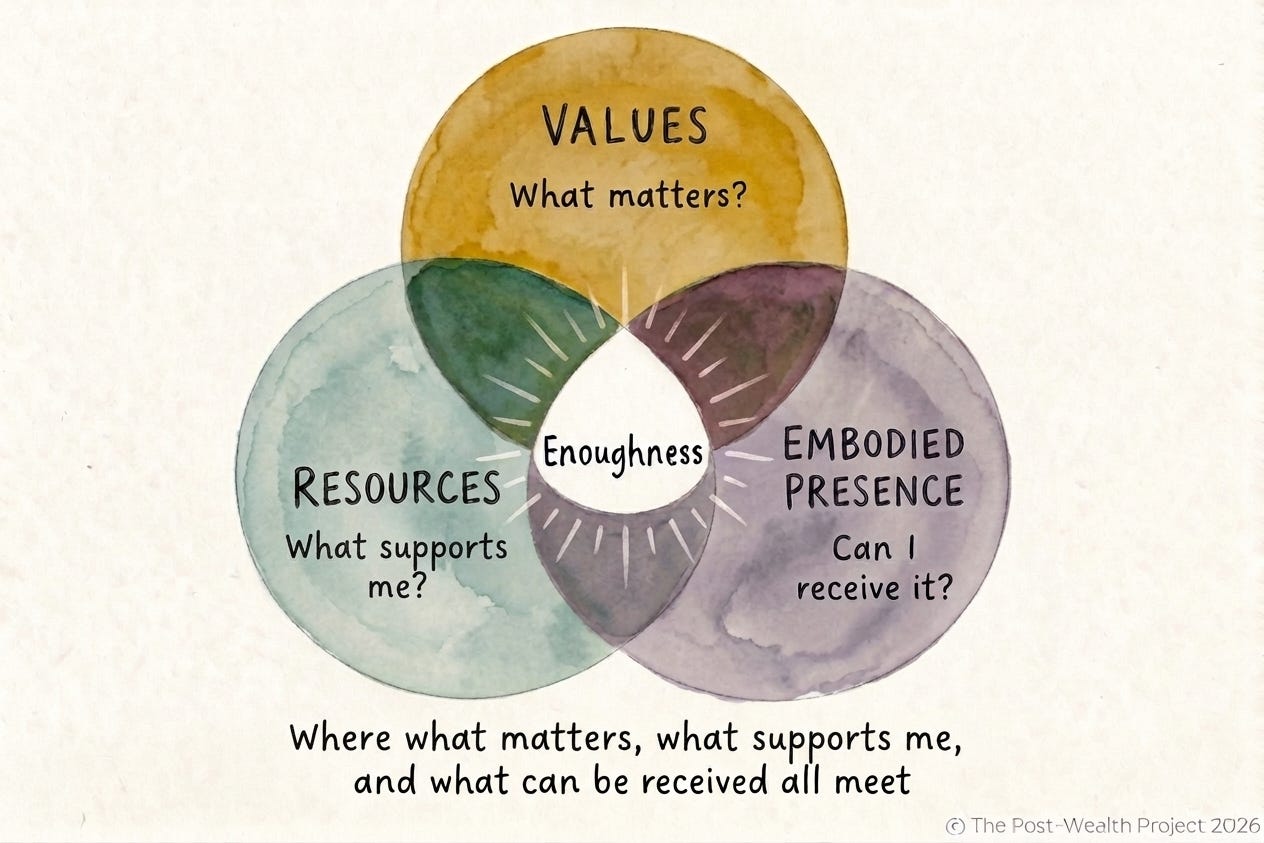
Why ecology? Ecology is, at heart, a study of relationships, located in sites of interaction. In an ecology, nothing changes alone. The dimensions that have emerged through this work - Resources, Values, and Embodied Presence - are in constant conversation with each other. A shift in one leads to a downstream cascade. The onslaught of luxury content in my feed triggered comparison, which awakened craving. Suddenly, the values that had been tethering me felt distant. My nervous system became dysregulated—cranky and anxious—and I sought soothing by checking my spreadsheet, hoping the math could answer a question it never could: What is enough?
But the answer isn’t in the spreadsheet. Enoughness arises through the ongoing relationship of these three dimensions. All three must be present in order for Enoughness to emerge. In the introductory essay to this series, I wrote:
The alignment matters. We can have sufficient resources and still feel deprived if we lose sight of what those resources are meant to serve. We can be deeply connected to our values but lack the resources to enact them. We can have both resources and values, but remain disconnected from the realities of our lives, forever pursuing a version of ourselves that no longer exists. But when our values, resources, and embodied presence align, we can finally recognize that we already have enough.
Each dimension invites a different kind of inquiry and cultivates a distinct human capacity. Resources asks, What supports me? Values asks, What matters? Embodied Presence asks, What can I receive? While each illuminates one facet of enoughness, it is only through their alignment that the lived experience of enoughness emerges.
Resources
As I thought about my own story and learned about other people’s experiences, I kept noticing one move: the reach for the certainty of numbers when things felt dicey. Some reach for the spreadsheet and start doing math. Others log into their brokerage, or call their advisors, asking for assurance that the number still worked, that the math was still mathing.
Why this move, over and over, toward numbers? What are we hoping the numbers will tell us? Have we learned somewhere that the spreadsheet, or the number, is the complete map of what supports us? And if that’s wrong…what else belongs there?
I started to realize that my inventory was incomplete. While I reached for numbers in moments of uncertainty, they rarely provided an answer that put my anxiety to permanent rest. I thought about all the moments in my life when I had experienced support. The time when a friend offered me a place to live when I left my marriage. The time when my brother moved my stuff out of an ex-boyfriends house when it was too dangerous for me to go there. The time when I was waitressing and turned a tableside conversation into an introduction into a job offer. Those things didn’t appear on the spreadsheet. They didn’t show up when I logged into Vanguard to check my number. And yet, those were the things that had actually carried me.
I had understood resources as things that could be extracted, monetized, or commodified, and I was missing the full picture. By focusing only on money, I couldn’t see how wealthy I was or how truly diverse my portfolio of support was. When our attention narrows to the balance sheet, the support available to us appears only financial. No wonder we feel so anxious about it, and constantly reach for the spreadsheet, log into our brokerage, and check our net worth to make sure we are still ok. No wonder the number seems all-important when it is the only capital we’re tracking.
Thinking back to the most challenging times in my life, financial capital allowed me to stay more comfortable. For example, I could afford to rent my own place when I left my marriage instead of sleeping in my friend’s guest bedroom. But it was the other forms of support that really sustained me - the social capital that meant I didn’t have to be alone during tough times. The spiritual capital that meant I had resources to maintain my gratitude and acceptance. The physical capital that got me up and out into the world every day despite so often wanting to stay in bed. Those are the things that really paid dividends that I couldn’t have replaced with anything else.
Building confidence in our resources includes taking financial inventory, but it goes far beyond that. If we want a full view of the support available to us, we need to think beyond money. When we think beyond money, we become less obsessed or worried about losing it. We have more confidence in our ability to sustain ourselves with a wide variety of resources. This is true for me. When I am in touch with the breadth of my resources, I can loosen my grip on money and enjoy my wealth more because I understand that it is not the foundation upon which my life rests. If panic arises, I remind myself that I am wealthy beyond what my net worth adds up to. I remember that I too am a resource. I connect to my deep capacity, drawing upon many types of capital, to adapt to changing circumstances, my ability to find meaning, purpose, and possibility wherever I am. I believe in yours, too—even if you don’t yet.
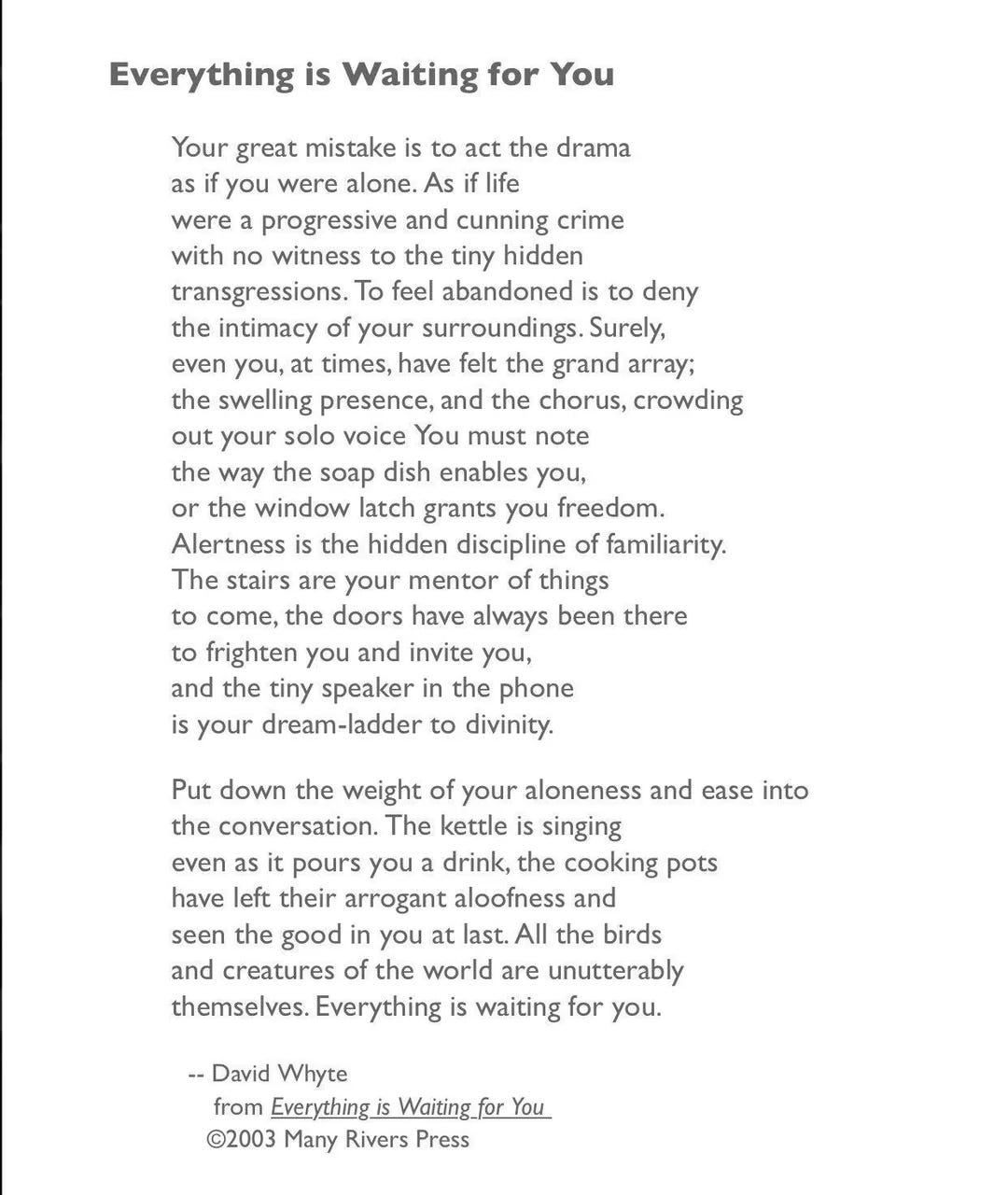
Everything is waiting for you
This poem by David Whyte so beautifully captures the depth of resourcing that is available in life - from the most mundane things to the most sacred.
Take inventory
Drawing on the Ecology of Enoughness, I’ve developed a tool to help you explore the many forms of capital that shape your capacity to meet life—social, physical, cultural, spiritual, and more. As you reflect on each one, you’ll build a more complete picture of the resources already present in your life, as well as the places where further cultivation may strengthen your resilience.
This inventory is an invitation to widen the lens. At the end of the inventory, you’ll receive personalized suggestions for developing each area. Think of these not as prescriptions, but as invitations. The goal isn’t to maximize every form of capital. It’s to develop a relationship with your resources that is broad enough to support the life you’re actually devoted to.
You may discover that you are wealthier than you imagined. You may also discover areas that deserve your care and attention. Both are valuable. Both bring you closer to the lived experience of enough.
Take your time. There are no right answers—only an opportunity to see yourself, and your sources of support, more clearly.

Taking a wider inventory of our resources is not an invitation to ignore financial reality. Enoughness cannot be built on avoidance. We still need to understand our spending, plan for the future, align our investments with our lives, and know what our money can—and cannot—support. Without that grounding, a felt sense of abundance can easily become another form of spiritual bypassing.
The point is not to replace the spreadsheet, but to return it to its proper place. Financial capital is one essential part of the ecology—not the whole of it. When we can see both the strength of our financial position and the wider network of capacities, relationships, and forms of support available to us, the numbers become information rather than a verdict on whether we will be okay.
Further Reading and Resources
If your inventory reveals that you need a stronger understanding of your financial capital, I recommend these resources for education.
Self-study: I’ve learned a great deal from the Reddit communities Bogleheads, FIRE, and ChubbyFire as well as the Bogleheads Wiki.
Spending: Monarch has been an essential tool for understanding my spending habits and creating intentional plans for the future.
Books: The Simple Path to Wealth by JL Collins is probably the only introductory book on investing most people will ever need.
Professionals: Although I no longer work with a financial planner myself, I still believe there is value in speaking with a fee-only financial planner to understand what they might offer in your particular situation. Two professionals whose work I deeply respect are Elizabeth George, CFP, author of Use Your Wealth, and Emilie Dayan Hill, CFA, author of Finance with Feeling. I’ve spoken with both of them and appreciate the thoughtful, holistic perspective they bring to conversations about money.
Keep Reading:
You Have Enough. So Why Doesn't It Feel That Way?

Most people imagine that having a lot of money means that you don’t worry about money anymore. Surely if you have accrued a few million dollars, you don’t sweat the small stuff anymore, right?
Hyperagency and the asymmetry of wealth

The sky is blue today in Costa Rica. Orchids and ferns grow along the trunk of the mango tree in the courtyard of our rental home. Winter weather and seasonal depression once structured my January; now I structure my January around sunshine and warmth. This is our fourth winter here, and it’s the first time I haven’t been employed full time for someone …
r
The anxiety of the spreadsheet can never be alleviated by more money alone. It's such a good point that we have to cultivate other types of capital to ever feel truly at ease.